Thursday, 24 November 2011
Spain Made Flesh: Penélope Cruz and La niña de tus ojos (Fernando Trueba, 1998)
The stardom of Penélope Cruz can be dated precisely as beginning in 1992 with the release of Jamón jamón (Bigas Luna, 1992) and Belle epoque (Fernando Trueba, 1992). The two films side by side encapsulate two facets of her star image; on the one hand, Cruz’s position as what Eugenia de la Torriente describes as the ‘mito erótico nacional’ [‘national erotic myth’] (2004: 38) as Silvia in Jamón jamón, and on the other, the virginal ideal in the character of Luz in Belle epoque. But they also caused her to debut on the national stage in two films that either consciously questioned and parodied Spanish identities or conflated contemporary Spain with Spain’s past; Cruz’s emergence at a time when Spanish identity was openly being discussed and Spain was actively (and publicly) trying to redefine itself has shaped the form and content of her stardom, the ways in which she interacts with the national, and the image of Spanishness that she represents as an end result. From the outset of her career, Penélope Cruz has also been constructed as a star who specifically ‘belongs’ to Spain: a number of Spanish female stars have emerged in the last twenty years but none are so possessively claimed as she. Cruz is commonly referred to in the Spanish press as ‘nuestra Penélope’ [‘our Penélope’] and her star image is presented as signifying innate aspects of Spanish womanhood, and she is seen as embodying Spain, or ‘España hecha carne’ [‘Spain made flesh’] in the words of director Bigas Luna (Trashorras 1999: 132).
Peter Evans notes how many daughters she has played onscreen and describes her as ‘la “niña”, es decir, la de todos los espectadores, la de toda España, a la que se refieren a menudo como “nuestra Penélope”’ [‘the little girl, that is to say, that of all the spectators, that of all of Spain, she who they refer to at least as “our Penélope”’] (2004: 54-55). This is further emphasised by the roles that are located within a specifically Spanish context: the arrival of the Second Republic in Belle epoque; incarcerated as a ‘political subversive’ during the last years of the dictatorship in Entre rojas (Azucena Rodríguez, 1995); a ‘gran estrella’ recalling Imperio Argentina in La niña de tus ojos / The Girl of Your Dreams (Fernando Trueba, 1998); Goya’s model for ‘La maja vestida’ and ‘La maja desnuda’ in Volavérunt (Bigas Luna, 1999); as well as her short role in the prologue (set during the ‘state of exception’ in 1970) of Carne trémula / Live Flesh (Pedro Almodóvar, 1997). These films position Cruz and her star image within narratives that have cultural and historical significance to Spain and therefore embed her within the cultural imaginary: ‘a nation is nothing without the stories it tells itself about itself’ (Triana-Toribio 2003: 6). This post examines the representation of Penélope Cruz as embodying Spain, specifically in the film La niña de tus ojos, the film for which she won her first Goya for Best Actress in 1999.
Thursday, 10 November 2011
Another Book Added to List
Resina, J.R. (ed) (2008) -Burning Darkness: A Half Century of Spanish Cinema, Albany, NY: State University of New York Press. ISBN: 978-0791475041
A collection that covers an interesting range of films with the aim of contributing to the as-yet still scarce range of English-language analytical resources that address Spanish cinema. The selection of films and directors has been done so as to span 'the period from the origins of the New Spanish Cinema in the 1950s to the end of the twentieth century' (p.1).
- Introduction -Joan Ramon Resina
- 1. Rehearsing for Modernity in ¡Bienvenido, Mister Marshall! (Luis García Berlanga, 1952) -Eva Woods Peiró
- 2. Existential Crossroads in Muerte de un ciclista (Juan Antonio Bardem, 1955) -Andrés Lima-Hincapié
- 3. Viridiana Coca-Cola (Luis Buñuel, 1961) -Tom Conley
- 4. El espíritu de la colmena: Memory, Nostalgia, Trauma (Víctor Erice, 1973) -Chris Perriam
- 5. A Poetics of Splitting: Memory and Identity in La prima Angélica (Carlos Saura, 1974) -Ángel Quintana
- 6. Ambiguous Disenchantment in El corazón del bosque (Manuel Gutiérrez Aragón, 1979) -Irení Depetris-Chauvin
- 7. Los paraísos perdidos: Cinema of Return and Repetition (Basilio Martín Patino, 1985) -Tatjana Pavlović
- 8. (M)Othering Strategies in El pájaro de la felicidad (Pilar Miró, 1993) -Jaume Martí-Olivella
- 9. Abjection, Trauma, and the Material Image: La madre muerta (Juanma Bajo Ulloa, 1993) -Jo Labanyi
- 10. The Catalan Body Politic as Aired in La teta i la lluna (Bigas Luna, 1994) -Dominic Keown
- 11. Genre and Screen Violence: Revisiting Tesis (Alejandro Amenábar, 1995) -Barry Jordan
- 12. Conceptualizing "the Impact" in Los amantes del Círculo Polar (Julio Medem, 1998) -Robert A. Davidson
- 13. Immortal/Undead: The Body and the Transmission of Tradition in Amic/Amat (Ventura Pons, 1998) -Josep-Anton Fernández
- 14. Imitation of Life: Transsexuality and Transtextuality in Todo sobre mi madre (Pedro Almodóvar, 1999) -Esteve Riambau
- 15. The Construction of the Cinematic Image: En construcción (José Luis Guerín, 2000) -Joan Ramon Resina
The book has been added to the Books on Spanish Cinema, Part Two post.
Tuesday, 18 October 2011
New Book Added to List
Torres Hortelano, L.J. (ed.) (2011) - Directory of World Cinema: Spain, Bristol: Intellect. ISBN: 9781841504636
This book forms part of a relatively new series from Intellect looking at various world cinemas. The aim is that future volumes will be added to each country's directory every couple of years (this volume makes tentative references to possible subjects to be included in future editions). On the back cover it says: 'Each volume of the directory will take the form of a collection of reviews, longer essay, and research resources, accompanied by film stills highlighting significant films and players.'
The book is divided into different sections encompassing focusses on specific directors, locations, film festivals, cultural background, and genres. The genres (some of which are specific to Spain) form the backbone of the directory with the ten different genre sections including an essay and then reviews of ten films that fall within that genre (although this is sometimes 'loosely' / bizarrely interpreted -for example, how did Cesc Gay's En la ciudad come to be classified as 'Experimental Documentary'?). Although 100 films are included, the editor is very clear in saying that this is not a '100 Best Spanish Films' enterprise, but rather the intention is to give a flavour of the variety within Spanish cinema. Future volumes would look at different genres. One could argue about the omissions (I know that it is often said that Almodóvar overshadows everyone else, but to only include one Almodóvar film feels an overcorrection too far in the other direction -especially when other directors have multiple films included. Plus, the Torrente phenomenon deserves some coverage) but, as this is seen as a project that will develop over time, perhaps those absences will be addressed in the future ('films about the Civil War' is a category that is mentioned for inclusion in the possible second volume).
This is more a book to dip in and out of rather than to read cover to cover (I haven't read all of it yet), but it's probably a good starting point for someone who is interested in watching Spanish films but doesn't know where to begin. As is often the case with books with multiple contributors (70, in this case), the style and quality of the writing is variable (some of the reviews lean towards the descriptive rather than the analytical, others seem to have suffered in translation), but an interesting aspect to the collection of contributors is how many of them are Spanish; it is relatively rare to see Spanish views on Spanish cinema published in English. Overall, a good introduction to the variety that Spanish cinema has to offer, but more of a starting point for further investigation than a one-stop-shop.
The table of contents is below, and because the impetus behind my starting the book lists was my frustration with being unable to find out what films are covered in a particular book, I'm going to include the (original) film titles of those reviewed in the various sections (but not the contributor names because of the vast number).
Introduction by the Editor
Film of the Year: Biutiful
Interview with Jaime Rosales
Industry Spotlight: Spanish Film Production
Cultural Crossover
-Influence of European Avant-garde
-Representations of Violence
-Don Quixote Visual Ridings
Festival Focus
-Semana de Cine Experimental de Madrid / Experimental Film Week of Madrid
Film Location: Madrid
Directors:
-Edgar Neville
-Fernando Fernán-Gómez
-Carlos Saura
-Victor Erice
-Pedro Almodóvar
Auteur Melodrama / Melodrama de autor
-Essay
-Reviews (Jamón, jamón (Bigas Luna, 1992), Todo sobre mi madre (Almodóvar, 1999), Cielo negro (Mur Oti, 1951), Caótica Ana (Medem, 2007), La vida mancha (Urbizu, 2003), My Life Without Me (Coixet, 2003), La ardilla roja (Medem, 1993), The Secret Life of Words (Coixet, 2005), Things I Never Told You (Coixet, 1996), Las voces de la noche (García Ruiz, 2003)).
Grotesque Comedy / Esperpento
-Essay
-Reviews (Amanece, que no es poco (Cuerda, 1988), Atraco a las tres (Forqué, 1962), Belle epoque (Trueba, 1992), El verdugo (García Berlanga, 1963), El milagro de P Tinto (Fesser, 1998), La escopeta nacional (García Berlanga, 1978), Plácido (García Berlanga, 1961), La linea del cielo (Colomo, 1983), El extraño viaje (Fernán-Gómez, 1964), Los tramposos (Lazaga, 1959)).
Iberian Drama
-Essay
-Reviews (Solas (Zambrano, 1999), Alas de mariposa (Bajo Ulloa, 1991), En la ciudad sin límites (Hernández, 2002), Flores del otro mundo (Bollaín, 1999), La casa de Bernarda Alba (Camus, 1987), La caza (Saura, 1965), Los lunes al sol (León de Aranoa, 2002), Poniente (Gutiérrez, 2002), La soledad (Rosales, 2007), Viridiana (Buñuel, 1961)).
Musical (But Not Only Flamenco...)
-Essay
-Reviews (¡Ay, Carmela! (Saura, 1990), Morena clara (Rey, 1936), Flamenco (Saura, 1995), La niña de tus ojos (Trueba, 1998), Pena, penita, pena (Morayta, 1953), El otro lado de la cama (Martínez Lázaro, 2002), Shirley Temple Story (Padrós, 1976), Canciones para después de una guerra (Patino, 1976), Embrujo (Serrano de Osma, 1946)).
Period Films / De época
-Essay
-Reviews (Alatriste (Díaz Yanes, 2006), Bocage (Leitão de Barros, 1936), Vacas (Medem, 1992), El perro del hortelano (Miró, 1996), Honor de cavalleria (Serra, 2006), Los últimos de Filipinas (Román, 1945), Locura de amor (Orduña, 1948), Nuestra Señora de Fátima (Gil, 1951), Sin novedad en el Alcázar (Genina, 1940), You Are the One (Una historia de entonces) (Garci, 2000)).
Dictatorship Forgotten Cinema
-Essay
-Reviews (Un hombre va por el camino (Mur Oti, 1949), Carmen fra i rossi (Neville, 1939), Surcos (Nieves Conde, 1951), La vida en un hilo (Neville, 1945), Calle Mayor (Bardem, 1956), Marcelino pan y vino (Vajda, 1955), El clavo (Gil, 1944), Historias de la radio (Sáenz de Heredia, 1955), El espíritu de la colmena (Erice, 1973), Vida en sombras (Llobet Gracia, 1948)).
The Transition to Democracy Cinema / Cine de la Transición
-Essay
-Reviews (El desencanto (Chávarri, 1976), El bosque animado (Cuerda, 1987), Los santos inocentes (Camus, 1984), La vieja memoria (Camino, 1979), Furtivos (Borau, 1975), Arrebato (Zulueta, 1979), Los restos del naufragio (Franco, 1978), 7 días de enero (Bardem, 1979), Habla, mudita (Gutiérrez Aragón, 1973), El viaje a ninguna parte (Fernán-Gómez, 1986)).
Crime and Thriller
-Essay
-Reviews (Angustia (Bigas Luna, 1987), Bilbao (Bigas Luna, 1978), Domingo de carnaval (Neville, 1945), Muerte de un ciclista (Bardem, 1955), El cebo (Vajda, 1958), Nadie hablará de nosotras cuando hayamos muerto (Díaz Yanes, 1995), Los peces rojos (Nieves Conde, 1955), Soldados de Salamina (Trueba, 2003), Tesis (Amenábar, 1996), Los cronocrímenes (Vigalondo, 2007)).
Fantasy and Horror
-Essay
-Reviews (El día de la bestia (de la Iglesia, 1995), El espinazo del diablo (del Toro, 2001), La Residencia (Ibáñez Serrador, 1969), Acción mutante (de la Iglesia, 1993), El orfanato (Bayona, 2007), The Others (Amenábar, 2001), El laberinto del fauno (del Toro, 2006), La cabina (Mercero, 1972), [Rec] (Balagueró and Plaza, 2007), La torre de los siete jorobados (Neville, 1944)).
Experimental Documentary
-Essay
-Reviews (El cant dels ocells (Serra, 2008), Contactos (Viota, 1970), El sol del membrillo (Erice, 1992), En la ciudad (Gay, 2003), Las Hurdes. Tierra sin pan (Buñuel, 1933), Die stille vor Bach (Portabella, 2007), Tren de sombras: El espectro de Le Thuit (Guerín, 1997), Umbracle (Portabella, 1972), Un chien andalou (Buñuel, 1929), Aguaespejo granadino (Val de Omar, 1953-1955)).
Recommended Reading
Spanish Cinema Online
Notes on Contributors
Glossary
Filmography
The book has been added to the Books on Spanish Cinema, Part Two post.
Wednesday, 31 August 2011
….and Almodóvar Month ends
So, the 31 days of Pedro celebration are now over, and all eighteen films have featured in some way on the blog. It’s a shame that I wasn’t overly enamoured with film no.18, but that’s the way it goes sometimes and I’ll be the first in line again when no.19 arrives.
My original plan for Almodóvar Month had been to write about my ten favourite Almodóvar films but I had to change that when the release date moved from November to August. I may write longer posts on some those films in the future (three of them had longer posts this month), but I’ve realised that I’ve not actually said what my ten favourites are –so, as the final post of Nobody Knows Anybody’s Almodóvar Month, here is my personal top ten. UPDATE 18/04/2026: the posts on individual films have been removed (apart from the one for La piel que habito) for reasons explained in the first post of the blogathon.
- 1. Talk to Her
- = Volver
- 3. Dark Habits
- 4. Bad Education
- 5. All About My Mother
- = High Heels
- = Women on the Verge of a Nervous Breakdown
- 8. Live Flesh
- 9. What Have I Done To Deserve This?
- 10. Law of Desire
Labels:
Almodóvar Month
Monday, 29 August 2011
La piel que habito / The Skin I Live In (Pedro Almodóvar, 2011)
Director: Pedro Almodóvar
Screenplay: Pedro Almodóvar and Agustín Almodóvar, based on the novel Mygale (a.k.a. Tarantula) by Thierry Jonquet.
Cast: Antonio Banderas, Elena Anaya, Marisa Paredes, Jan Cornet, Blanca Suárez, Roberto Álamo, Eduard Fernández, Susi Sánchez, Bárbara Lennie, Fernando Cayo, José Luis Gómez.
Short version: A rich and macabre body-horror with touches of melodrama, well executed, with excellent performances, but not my cup of tea.
WARNING: SPOILERS ARE INCLUDED -THE FILM IS BEST VIEWED WITHOUT PRIOR KNOWLEDGE
Friday, 26 August 2011
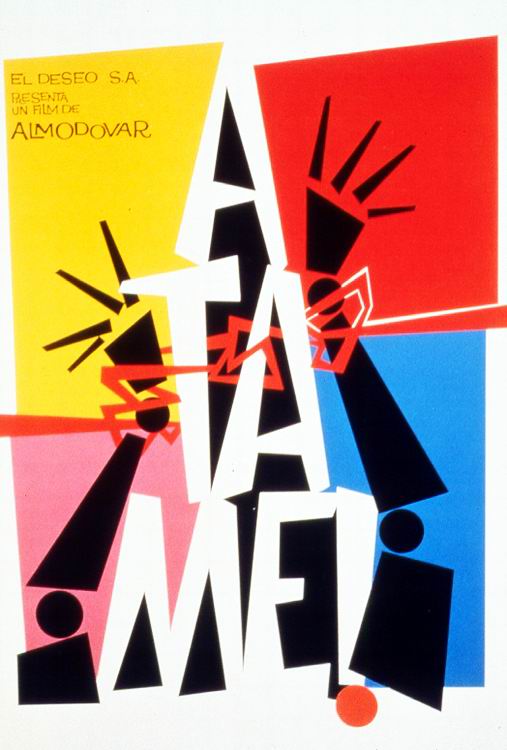
My 5 Favourite Almodóvar Film Posters
I should be seeing La piel que habito / The Skin I Live In over the weekend, with a post to follow at the start of the next week. In the meantime, here are my five favourite posters for Almodóvar films.
I’ve got the UK Quad poster version of this (i.e. landscape rather than portrait –with the picture on one side and the wording on the other) on my wall. Also look for the Japanese mini poster (chirashi) version, which has Cruz emerging from a bouquet of flowers. It’s a really bold poster and I like how it uses the colour that Almodóvar is most associated with (red) and integrates the pattern from one of Raimunda’s outfits (I think it was either Peter Bradshaw or Jonathan Romney who said that on the basis of this film, Cruz has to be one of the few women in the world who could wear anything that Primark could possibly throw at her). In my longer post about the film I suggest that Volver is kind of an old-fashioned ‘star vehicle’ for Penélope Cruz –it is to an extent built around her existing star image- and her centrality on the poster (and to my knowledge her image was the only one that appeared in promotional materials, although I could be wrong) supports that.
Another Gatti design, another poster that I have on my wall (although not full size). There are several different posters for Women on the Verge but this is my favourite –it captures several things about the film: its overall stylised nature (which starts in the opening credits (also designed by Gatti –the images on the poster are in the credit sequence)), the prominence of primary colours in the set design, and that although there is a central character (Pepa –Carmen Maura), there is more than one woman in the film who is on the verge of a nervous breakdown.
The poster contains several elements from the film. Most obviously the tiger that the nuns keep in the garden of the convent, but here the tiger is standing for the Mother Superior (played by Julieta Serrano). Note that Yolanda (Cristina Pascual), wearing the dress that she’s wearing when she arrives at the convent, is becoming ensnared in the tiger’s claws, an indication that she risks being devoured by the Mother Superior if she is not careful. But also note that the tiger’s claws are scratching the habit –the Mother Superior is damaging herself, and her behaviour is self-destructive. Apart from the nun’s habit, the poster also contains the symbol of this particular Order (the Convent of the Humiliated Redeemers) –but instead of a heart surrounded by flames, instead it is pierced by syringes, which partly refers to what the nuns believe their mission is (the rescue ‘fallen’ girls, drug addicts seemingly prominent among them), but is also a reference the Mother Superior’s own addictions.
I just like the Saul Bass-ness of this one. It doesn’t work as well in the UK version because they try to fit ‘Tie Me Up! Tie Me Down!’ into the same space as ‘Átame!’.
I like the simplicity of this design, which again makes use of the colour red (the dominant colour within the film itself). The circle can be read in many ways –it puts the boy at the centre of a target (the priest pursues him), but it could also be a spotlight (pointing to the elements of ‘performance’ that surround Ignacio). The crossed arms also signal determination –something that can certainly be ascribed to Ignacio in his many different incarnations.
| Designer: Juan Gatti |
| Designer: Juan Gatti |
| Designer: Iván Zulueta |
| Designer: Juan Gatti |
| Designer: Juan Gatti |
Tuesday, 9 August 2011
Monday, 8 August 2011
Reading Almodóvar, Part One:
Like my lists of books on Spanish cinema, this is something of a cross between an annotated bibliography and a recommended reading list. This is not intended to be a definitive list –there are an abundance of other books and articles on Almodóvar and his films– but rather a list of texts that I have happened upon while researching Almodóvar, and / or Spanish cinema more generally. I don’t necessarily agree with all of the arguments or interpretations set forth by these authors, but I do think that their views are worth considering. The first Almodóvar film that I saw was Kika (1993), and this list contains a bias towards things written after that point (and about films made after that point as well). Likewise, there is a bias towards texts written in either English or Spanish, but given Almodóvar’s status in France there is also a wealth of material in French out there, if you care to look for it –particularly Cahiers du cinema, Positif, and Premiere (the French version). Most of the French magazines have websites where you can buy back issues (if you can’t get access to them through a library).
If I have embedded a link in the title, it will take you either to the abstract or the article itself –a great deal of material is now available online. Where that isn’t the case I will try to include enough information that you should be able to track it down via another route –if you can’t access the articles online, people in the UK will be able to get copies through the British Library or the BFI Library. In the case of reviews, I have just indicated which film is discussed.
Labels:
Almodóvar Month,
Books,
Resources
Monday, 1 August 2011
Almodóvar Month begins…
UPDATE 18/04/2026: I am removing most of the Almodóvar Month posts because of repeated copyright infringement claims from a company claiming to represent El Deseo - the claims get overturned when I appeal (because I haven't infringed copyright), but it has become quite irritating. I will leave the post about La piel que habito (as its release was the impetus for the blogathon), and the posts on books and posters, but remove everything on individual films because it seems to be the combination of an image with the synopsis and basic credits that triggers the claims.
So August has arrived, the countdown to the UK release (on the 26th) of La piel que habito / The Skin I Live In starts, and it’s Almodóvar Month here at Nobody Knows Anybody.
I haven’t managed to do quite what I wanted (in a previous post I said that I hoped to write about my ten favourite Almodóvar films), but I think I’ll actually manage to say something (however short) about all seventeen films and will write something about the eighteenth once I get to see it.
Here’s what will be appearing on the blog throughout August:
- I’ve written a paragraph on each of the films and those will be posted up in chronological order with basic credits and a synopsis.
- There will be an Almodóvar ‘book list’ in the style of the Spanish cinema ones I have posted previously.
- There will be a series of longer posts looking at specific films –including High Heels, Live Flesh, Talk to Her, and Volver. These won't be going up in chronological order because I'm still writing the High Heels one.
- There may also be some other things –for example, I’d quite like to write something about his film posters, but it depends on how much time I have.
Anyway, hopefully there’ll be something for everyone (providing they like the films), and please feel free to chip in via the comments section with your thoughts about the various films –have I underestimated one? Or over-praised another?
Labels:
Almodóvar Month
Sunday, 3 July 2011
Agnosia (Eugenio Mira, 2010)
Director: Eugenio Mira
Screenwriter: Antonio Trashorras
Cast: Bárbara Goenaga, Eduardo Noriega, Félix Gómez, Martina Gedeck, Sergi Mateu, Jack Taylor
Trailer: short version (haven’t been able to find the subtitled full-length version)
Availability: available to buy and rent in the UK.
Synopsis: Barcelona, 1899. Joana (Bárbara Goenaga) suffers from agnosia, a neuropsychological condition that affects her perception. Interested parties suspect that she is the only person who knows an industrial secret relating to her father’s business, and so a conspiracy evolves with the aim of obtaining the secret by deception. Two men, Carles (Eduardo Noriega), her fiancé, and Vicent (Félix Gómez), a servant, are her only form of protection. But can she trust them? And can she trust her own senses?
agnosia, n.
A condition in which people can see, but cannot recognise or interpret, visual stimuli; loss of perceptive power; loss of the power to recognise people or things seen.
Note: contains minor spoilers (although nothing that you couldn’t guess from the trailer).