Wednesday, 31 August 2011

….and Almodóvar Month ends


So, the 31 days of Pedro celebration are now over, and all eighteen films have featured in some way on the blog. It’s a shame that I wasn’t overly enamoured with film no.18, but that’s the way it goes sometimes and I’ll be the first in line again when no.19 arrives. 
My original plan for Almodóvar Month had been to write about my ten favourite Almodóvar films but I had to change that when the release date moved from November to August. I may write longer posts on some those films in the future (three of them had longer posts this month), but I’ve realised that I’ve not actually said what my ten favourites are –so, as the final post of Nobody Knows Anybody’s Almodóvar Month, here is my personal top ten. UPDATE 18/04/2026: the posts on individual films have been removed (apart from the one for La piel que habitofor reasons explained in the first post of the blogathon.
  • 1. Talk to Her
  • = Volver
  • 3. Dark Habits
  • 4. Bad Education
  • 5. All About My Mother
  • = High Heels
  • = Women on the Verge of a Nervous Breakdown
  • 8. Live Flesh
  • 9. What Have I Done To Deserve This?
  • 10. Law of Desire

Monday, 29 August 2011

La piel que habito / The Skin I Live In (Pedro Almodóvar, 2011)


Director: Pedro Almodóvar
Screenplay: Pedro Almodóvar and Agustín Almodóvar, based on the novel Mygale (a.k.a. Tarantula) by Thierry Jonquet.
Cast: Antonio Banderas, Elena Anaya, Marisa Paredes, Jan Cornet, Blanca Suárez, Roberto Álamo, Eduard Fernández, Susi Sánchez, Bárbara Lennie, Fernando Cayo, José Luis Gómez.

Short version: A rich and macabre body-horror with touches of melodrama, well executed, with excellent performances, but not my cup of tea.

WARNING: SPOILERS ARE INCLUDED -THE FILM IS BEST VIEWED WITHOUT PRIOR KNOWLEDGE

Friday, 26 August 2011

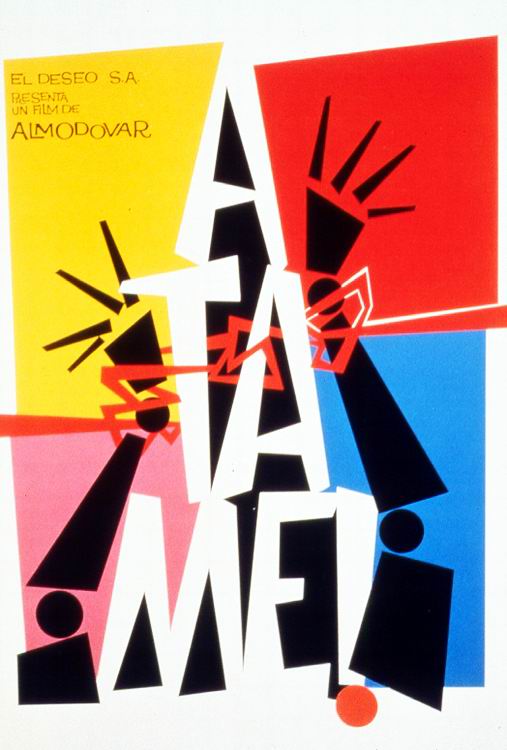
My 5 Favourite Almodóvar Film Posters

I should be seeing La piel que habito / The Skin I Live In over the weekend, with a post to follow at the start of the next week. In the meantime, here are my five favourite posters for Almodóvar films.

Designer: Juan Gatti 
I’ve got the UK Quad poster version of this (i.e. landscape rather than portrait –with the picture on one side and the wording on the other) on my wall. Also look for the Japanese mini poster (chirashi) version, which has Cruz emerging from a bouquet of flowers. It’s a really bold poster and I like how it uses the colour that Almodóvar is most associated with (red) and integrates the pattern from one of Raimunda’s outfits (I think it was either Peter Bradshaw or Jonathan Romney who said that on the basis of this film, Cruz has to be one of the few women in the world who could wear anything that Primark could possibly throw at her). In my longer post about the film I suggest that Volver is kind of an old-fashioned ‘star vehicle’ for Penélope Cruz –it is to an extent built around her existing star image- and her centrality on the poster (and to my knowledge her image was the only one that appeared in promotional materials, although I could be wrong) supports that.

Designer: Juan Gatti
Another Gatti design, another poster that I have on my wall (although not full size). There are several different posters for Women on the Verge but this is my favourite –it captures several things about the film: its overall stylised nature (which starts in the opening credits (also designed by Gatti –the images on the poster are in the credit sequence)), the prominence of primary colours in the set design, and that although there is a central character (Pepa –Carmen Maura), there is more than one woman in the film who is on the verge of a nervous breakdown.

Designer: Iván Zulueta
The poster contains several elements from the film. Most obviously the tiger that the nuns keep in the garden of the convent, but here the tiger is standing for the Mother Superior (played by Julieta Serrano). Note that Yolanda (Cristina Pascual), wearing the dress that she’s wearing when she arrives at the convent, is becoming ensnared in the tiger’s claws, an indication that she risks being devoured by the Mother Superior if she is not careful. But also note that the tiger’s claws are scratching the habit –the Mother Superior is damaging herself, and her behaviour is self-destructive. Apart from the nun’s habit, the poster also contains the symbol of this particular Order (the Convent of the Humiliated Redeemers) –but instead of a heart surrounded by flames, instead it is pierced by syringes, which partly refers to what the nuns believe their mission is (the rescue ‘fallen’ girls, drug addicts seemingly prominent among them), but is also a reference the Mother Superior’s own addictions.

Designer: Juan Gatti
I just like the Saul Bass-ness of this one. It doesn’t work as well in the UK version because they try to fit ‘Tie Me Up! Tie Me Down!’ into the same space as ‘Átame!’.

Designer: Juan Gatti
I like the simplicity of this design, which again makes use of the colour red (the dominant colour within the film itself). The circle can be read in many ways –it puts the boy at the centre of a target (the priest pursues him), but it could also be a spotlight (pointing to the elements of ‘performance’ that surround Ignacio). The crossed arms also signal determination –something that can certainly be ascribed to Ignacio in his many different incarnations.

Monday, 8 August 2011

Reading Almodóvar, Part One:

Like my lists of books on Spanish cinema, this is something of a cross between an annotated bibliography and a recommended reading list. This is not intended to be a definitive list –there are an abundance of other books and articles on Almodóvar and his films– but rather a list of texts that I have happened upon while researching Almodóvar, and / or Spanish cinema more generally. I don’t necessarily agree with all of the arguments or interpretations set forth by these authors, but I do think that their views are worth considering. The first Almodóvar film that I saw was Kika (1993), and this list contains a bias towards things written after that point (and about films made after that point as well). Likewise, there is a bias towards texts written in either English or Spanish, but given Almodóvar’s status in France there is also a wealth of material in French out there, if you care to look for it –particularly Cahiers du cinema, Positif, and Premiere (the French version). Most of the French magazines have websites where you can buy back issues (if you can’t get access to them through a library).
If I have embedded a link in the title, it will take you either to the abstract or the article itself –a great deal of material is now available online. Where that isn’t the case I will try to include enough information that you should be able to track it down via another route –if you can’t access the articles online, people in the UK will be able to get copies through the British Library or the BFI Library. In the case of reviews, I have just indicated which film is discussed.

Monday, 1 August 2011

Almodóvar Month begins…


UPDATE 18/04/2026: I am removing most of the Almodóvar Month posts because of repeated copyright infringement claims from a company claiming to represent El Deseo - the claims get overturned when I appeal (because I haven't infringed copyright), but it has become quite irritating. I will leave the post about La piel que habito (as its release was the impetus for the blogathon), and the posts on books and posters, but remove everything on individual films because it seems to be the combination of an image with the synopsis and basic credits that triggers the claims.

So August has arrived, the countdown to the UK release (on the 26th) of La piel que habito / The Skin I Live In starts, and it’s Almodóvar Month here at Nobody Knows Anybody.
I haven’t managed to do quite what I wanted (in a previous post I said that I hoped to write about my ten favourite Almodóvar films), but I think I’ll actually manage to say something (however short) about all seventeen films and will write something about the eighteenth once I get to see it.

Here’s what will be appearing on the blog throughout August:
  • I’ve written a paragraph on each of the films and those will be posted up in chronological order with basic credits and a synopsis.
  • There will be an Almodóvar ‘book list’ in the style of the Spanish cinema ones I have posted previously.
  • There will be a series of longer posts looking at specific films –including High Heels, Live Flesh, Talk to Her, and Volver. These won't be going up in chronological order because I'm still writing the High Heels one.
  • There may also be some other things –for example, I’d quite like to write something about his film posters, but it depends on how much time I have.

Anyway, hopefully there’ll be something for everyone (providing they like the films), and please feel free to chip in via the comments section with your thoughts about the various films –have I underestimated one? Or over-praised another?