Thursday, 22 December 2011

My Top 5 Spanish Films Viewed in 2011

Given that I don't live in Spain, I tend to see films when they're released on DVD; usually a year after their initial cinema release. So, these films aren't all 'from' 2011 but I've limited myself to films that were released in Spanish cinemas in either 2011 or 2010. This top 5 is comprised of films that I viewed this year and wrote about on the blog -either as standalone posts, or as part of the Random Viewing thread.


1. Primos (Daniel Sánchez Arévalo, 2011)
A warm hug of a film -the affection that writer-director Daniel Sánchez Arévalo has for his characters is infectious. The collection of actors (Quim Gutierrez, Antonio de la Torre, Raúl Arévalo) who are becoming his de facto repertory company also form (along with Adrián Lastra, Inma Cuesta, and Clara Lago) one of the best ensemble casts of the year.


2. Pa negre (Agustí Villaronga, 2010)
A dark and otherworldly tale of innocence lost. A child's eye view of adult deceit and destruction. One of the most brutal opening sequences I can remember ever watching.


3. La mitad de Óscar (Manuel Martín Cuenca, 2011)
Probably one of the most atmospheric films I saw this year (in any language); it makes distinctive use of the landscape / geographic space and also assuredly cranks up the tension (we know that something is being pointedly ignored by the two siblings (bravura performances from Rodrigo Sáenz de Heredia and Verónica Echegui) but it hovers just out of sight for most of the film). It builds to a quietly devastating final scene between the two siblings that plays out in one long take with them in silhouette as the sun rises behind them: a strong contender for scene of the year, in my opinion (I saw the film back in September and it is still stuck in my mind).


4. Todas las canciones hablan de mí (Jonás Trueba, 2010)
A brilliant comedic romantic drama -guaranteed to put a spring in your step. I will hopefully write something longer about it in the New Year (it has only been briefly covered in a Random Viewing post so far).


5. Balada triste de trompeta (Álex de la Iglesia, 2010)
Not quite as batshit insane as the trailer makes out but nonetheless full of vivid imagery that scorches your retina and refuses to leave your mind (along with that song, which I have been humming ever since). Whatever your opinion of the overall whole (people seem to be divided between hating it or declaring it a masterpiece), I'd hope that most would have at least a glimmer of admiration for a writer-director going this 'all out'. Plaudits also go to the three leads -Carlos Areces, Antonio de la Torre, and Carolina Bang- the film wouldn't work if they weren't all committed to their roles, or if one performance overwhelmed the other two. The film will hopefully have a standalone post early in the New Year.


Honourable mentions: La mosquitera (Agustí Vila, 2010), Chico y Rita (Fernando Trueba & Javier Mariscal, 2011), Agnosia (Eugenio Mira, 2010), Flamenco Flamenco (Carlos Saura, 2010), La piel que habito (Pedro Almodóvar, 2011), La mujer sin piano (Javier Rebollo, 2010) and Héroes (Pau Freixas, 2010).

Films from 2010* that I still need to track down: Bon appétit (David Pinillos, 2010), El Gran Vázquez (Óscar Aibar, 2010), La isla interior (Dunia Ayaso & Félix Sabroso, 2010), Pájaros de papel (Emilio Aragón, 2010), Que se mueran los feos (Nacho G. Velilla, 2010), También la lluvia (Icíar Bollaín, 2010), Todo lo que tú quieras (Achero Mañas, 2010). *films from 2011 that I still need to track down will appear in a forthcoming post.

Films that didn't fit the 2010 / 2011 criteria but that you should definitely see: Los cronocrímenes (Nacho Vigalondo, 2007), Salto al vacio (Daniel Calparsoro, 1995), La madre muerta (Juanma Bajo Ulloa, 1993 -I wrote two posts on this one –here and here), Nadie hablará de nosotras cuando hayamos muerto (Agustín Díaz Yanes, 1995 -a longer post on this one will appear in 2012), and Entre tinieblas (Pedro Almodóvar, 1983).

Hero of the Year: Filmin -without this Spanish streaming service I would have seen far fewer recent Spanish films (I first saw three of my top 5 via their service, and a further 4 of the honourable mentions) simply because of how expensive it is to import DVDs. I am also more likely to take a 'risk' on films that I know little about -as was the case with La mitad de Óscar- when using an all-included subscription service, which broadens the variety of films that this blog covers and hopefully makes it a bit more interesting.

I’ll be taking a break from the blog between Christmas and New Year –I’ll be back in January with posts on films from 2011 that I still want to catch up with, and on the Spanish films due for release in 2012 that I’m most interested in.

Merry Christmas –and I’ll ‘see’ you in 2012!

Tuesday, 20 December 2011

Not-So-Random-Viewing: Álex de la Iglesia Edition


Clockwise from top left: Balada triste de trompeta / The Last Circus (Álex de la Iglesia, 2010), 800 balas / 800 Bullets (Álex de la Iglesia, 2002), The Oxford Murders (Álex de la Iglesia, 2008), El día de la bestia / Day of the Beast (Álex de la Iglesia, 1995).


   Balada triste de trompeta featured in one of my first posts on this blog as one of the films from last year that I most wanted to catch up with in 2011. I'm going to write a standalone post about the film in (hopefully) January -I need to watch it again before attempting to write anything of any decent length and I won't have the time until after Christmas. [I know I quite often say that and things still haven't materialised, but Nadie hablará de nosotras cuando hayamos muerto and a joint post about Los lunes al sol and Biutiful are still percolating in my brain, honest].
   However, on first impressions it strikes me as a culmination of de la Iglesia's work to date and it will be interesting to see where he has gone with his next film, La chispa de la vida (due for release in Spain in January); Balada triste de trompeta almost feels like an end point in terms of certain themes that recur across the director's work. It is unmistakably 'an Álex de la Iglesia film' in terms of the vividness and inventiveness of the imagery and an extremity of violence that takes on an almost cartoon-like quality; this is filmmaking that is by turns both exhilarating and highly disturbing. The circus is the perfect setting for the lunacy, violence, dark humour, and cruelty that run through de la Iglesia's films; given the miscreants, misfits, and malcontents who populate his films, it is almost a surprise that he hasn't set a story in this world before (although several of his films take place within an entertainment setting -a television comedy double-act in Muertos de risa and a Western sideshow spectacle in 800 balas).
   It was the sense that Balada represents a culmination of his work that made me watch the only two of his films that I hadn't seen previously: 800 balas and The Oxford Murders. 800 balas is in many ways a paean to cinema, filmmaking, and the type of films 'they don't make anymore'. The film takes place on old film sets in Almeria (the location for many Westerns filmed in the 1950s/60s, including Sergio Leone's Dollars trilogy) where a former stuntman (Sancho Gracia) reenacts his glory days with a gang of reprobates as they stage a 'Western sideshow' for the dwindling number of visiting tourists. It is a warm tribute to a world that no longer exists. I had two surprises watching The Oxford Murders -1) that it was nowhere near as bad as the UK reviews had led me to believe, and 2) how little of de la Iglesia's normal visual style it contained; it was as if the tepid English sunlight had diluted his usual visual dazzling.
   Then I decided to rewatch El día de la bestia because it is my favourite of his films (and one of my favourite films, full stop) - and as it takes place on Christmas Eve it seemed appropriately festive (insofar as a film about a priest (Alex Angulo), a TV psychic / paranormal expert (Armando de Razza), and a death-metal fan (Santiago Segura) attempting to stop the birth of the Antichrist can be 'festive'). I've never understood why it isn't available in the UK (likewise his Carmen Maura-starring La comunidad (2000)) given that several of his other films are, and it currently also seems to be OOP in Spain. If you get the chance to see it, do so -it is very funny and a deeply affectionate take on the horror film.

Thursday, 8 December 2011

Another Book Added


Mira, A. (2010) -The A-Z of Spanish Cinema, Plymouth: The Scarecrow Press, Inc. ISBN: 9780810876224.

The merits of A-Z type compendiums have always appeared somewhat dubious to me as they usually tend towards the simplistic and obvious (although Routledge's Key Concepts series, which operates along similar lines, has always been excellent). Happily that is not the case here. I haven't come across The Scarecrow Press's A-Z series previously, but it covers a broad range of subjects -this book is no.244 in the series (nestled in between The A-Z of U.S. diplomacy from World War I through World War II and The A-Z of the Reformation and Counter-Reformation).
The book starts with a chronology of Spanish cinema between 1896 and 2008, then has a fairly substantial introductory chapter before moving onto the dictionary proper. The dictionary includes entries on key films, themes (including specifically Spanish terms such as costumbrismo), directors, writers, producers, and actors. I think it benefits from being the work of just one person because it feels like a unified whole with a consistent viewpoint and entries cross-referencing other entries. One can always quibble with what gets left out but actually the balance is pretty evenly struck between old and modern classics, and the range of individuals covered also feels varied (there is a mix of generations, but all are established names). But I think that the crowning glory is the 94-page bibliography. It is the most extensive and exhaustive bibliography on Spanish cinema that I've ever come across; I've been seeking these things out for years and this bibliography is seriously impressive (If you're the type of person who is impressed by bibliographies. Which I am). The bibliography is divided into several sections (some items appear in more than section): General and Reference; Origins and Silent Years (1896-1931); Republican Period and the Civil War (1931-1939); Early Francoism (1939-1960); The Desarrollismo Period and Late Francoism (1961-1975); Transition Period and Socialist Change (1975-1990); Recent Spanish Cinema (from 1990); Specific Filmmakers; Legislation and Economy; Autonomous Regions; Journals; Internet Sites. I've been merrily filling in Inter-Library Loan request forms ever since this book arrived through the post. If you're researching / interested in specific periods of Spanish cinema, or specific Spanish filmmakers, this book would be an excellent starting point.
Recommended.  

This will be added to Books on Spanish Cinema, Part Two 

Thursday, 24 November 2011

Spain Made Flesh: Penélope Cruz and La niña de tus ojos (Fernando Trueba, 1998)


      The stardom of Penélope Cruz can be dated precisely as beginning in 1992 with the release of Jamón jamón (Bigas Luna, 1992) and Belle epoque (Fernando Trueba, 1992). The two films side by side encapsulate two facets of her star image; on the one hand, Cruz’s position as what Eugenia de la Torriente describes as the ‘mito erótico nacional’ [‘national erotic myth’] (2004: 38) as Silvia in Jamón jamón, and on the other, the virginal ideal in the character of Luz in Belle epoque. But they also caused her to debut on the national stage in two films that either consciously questioned and parodied Spanish identities or conflated contemporary Spain with Spain’s past; Cruz’s emergence at a time when Spanish identity was openly being discussed and Spain was actively (and publicly) trying to redefine itself has shaped the form and content of her stardom, the ways in which she interacts with the national, and the image of Spanishness that she represents as an end result. From the outset of her career, Penélope Cruz has also been constructed as a star who specifically ‘belongs’ to Spain: a number of Spanish female stars have emerged in the last twenty years but none are so possessively claimed as she. Cruz is commonly referred to in the Spanish press as ‘nuestra Penélope’ [‘our Penélope’] and her star image is presented as signifying innate aspects of Spanish womanhood, and she is seen as embodying Spain, or ‘España hecha carne’ [‘Spain made flesh’] in the words of director Bigas Luna (Trashorras 1999: 132).
      Peter Evans notes how many daughters she has played onscreen and describes her as ‘la “niña”, es decir, la de todos los espectadores, la de toda España, a la que se refieren a menudo como “nuestra Penélope”’ [‘the little girl, that is to say, that of all the spectators, that of all of Spain, she who they refer to at least as “our Penélope”’] (2004: 54-55). This is further emphasised by the roles that are located within a specifically Spanish context: the arrival of the Second Republic in Belle epoque; incarcerated as a ‘political subversive’ during the last years of the dictatorship in Entre rojas (Azucena Rodríguez, 1995); a ‘gran estrella’ recalling Imperio Argentina in La niña de tus ojos / The Girl of Your Dreams (Fernando Trueba, 1998); Goya’s model for ‘La maja vestida’ and ‘La maja desnuda’ in Volavérunt (Bigas Luna, 1999); as well as her short role in the prologue (set during the ‘state of exception’ in 1970) of Carne trémula / Live Flesh (Pedro Almodóvar, 1997). These films position Cruz and her star image within narratives that have cultural and historical significance to Spain and therefore embed her within the cultural imaginary: ‘a nation is nothing without the stories it tells itself about itself’ (Triana-Toribio 2003: 6). This post examines the representation of Penélope Cruz as embodying Spain, specifically in the film La niña de tus ojos, the film for which she won her first Goya for Best Actress in 1999.

Thursday, 10 November 2011

Another Book Added to List


Resina, J.R. (ed) (2008) -Burning Darkness: A Half Century of Spanish Cinema, Albany, NY: State University of New York Press. ISBN: 978-0791475041

A collection that covers an interesting range of films with the aim of contributing to the as-yet still scarce range of English-language analytical resources that address Spanish cinema. The selection of films and directors has been done so as to span 'the period from the origins of the New Spanish Cinema in the 1950s to the end of the twentieth century' (p.1).

  • Introduction -Joan Ramon Resina
  • 1. Rehearsing for Modernity in ¡Bienvenido, Mister Marshall! (Luis García Berlanga, 1952) -Eva Woods Peiró
  • 2. Existential Crossroads in Muerte de un ciclista (Juan Antonio Bardem, 1955) -Andrés Lima-Hincapié
  • 3. Viridiana Coca-Cola (Luis Buñuel, 1961) -Tom Conley
  • 4. El espíritu de la colmena: Memory, Nostalgia, Trauma (Víctor Erice, 1973) -Chris Perriam
  • 5. A Poetics of Splitting: Memory and Identity in La prima Angélica (Carlos Saura, 1974) -Ángel Quintana
  • 6. Ambiguous Disenchantment in El corazón del bosque (Manuel Gutiérrez Aragón, 1979)  -Irení Depetris-Chauvin
  • 7. Los paraísos perdidos: Cinema of Return and Repetition (Basilio Martín Patino, 1985) -Tatjana Pavlović
  • 8. (M)Othering Strategies in El pájaro de la felicidad (Pilar Miró, 1993) -Jaume Martí-Olivella
  • 9. Abjection, Trauma, and the Material Image: La madre muerta (Juanma Bajo Ulloa, 1993) -Jo Labanyi
  • 10. The Catalan Body Politic as Aired in La teta i la lluna (Bigas Luna, 1994) -Dominic Keown
  • 11. Genre and Screen Violence: Revisiting Tesis (Alejandro Amenábar, 1995) -Barry Jordan
  • 12. Conceptualizing "the Impact" in Los amantes del Círculo Polar (Julio Medem, 1998) -Robert A. Davidson
  • 13. Immortal/Undead: The Body and the Transmission of Tradition in Amic/Amat (Ventura Pons, 1998) -Josep-Anton Fernández
  • 14. Imitation of Life: Transsexuality and Transtextuality in Todo sobre mi madre (Pedro Almodóvar, 1999) -Esteve Riambau
  • 15. The Construction of the Cinematic Image: En construcción (José Luis Guerín, 2000) -Joan Ramon Resina


The book has been added to the Books on Spanish Cinema, Part Two post.

Tuesday, 18 October 2011

New Book Added to List


Torres Hortelano, L.J. (ed.) (2011) - Directory of World Cinema: Spain, Bristol: Intellect. ISBN: 9781841504636

This book forms part of a relatively new series from Intellect looking at various world cinemas. The aim is that future volumes will be added to each country's directory every couple of years (this volume makes tentative references to possible subjects to be included in future editions). On the back cover it says: 'Each volume of the directory will take the form of a collection of reviews, longer essay, and research resources, accompanied by film stills highlighting significant films and players.'
The book is divided into different sections encompassing focusses on specific directors, locations, film festivals, cultural background, and genres. The genres (some of which are specific to Spain) form the backbone of the directory with the ten different genre sections including an essay and then reviews of ten films that fall within that genre (although this is sometimes 'loosely' / bizarrely interpreted -for example, how did Cesc Gay's En la ciudad come to be classified as 'Experimental Documentary'?). Although 100 films are included, the editor is very clear in saying that this is not a '100 Best Spanish Films' enterprise, but rather the intention is to give a flavour of the variety within Spanish cinema. Future volumes would look at different genres. One could argue about the omissions (I know that it is often said that Almodóvar overshadows everyone else, but to only include one Almodóvar film feels an overcorrection too far in the other direction -especially when other directors have multiple films included. Plus, the Torrente phenomenon deserves some coverage) but, as this is seen as a project that will develop over time, perhaps those absences will be addressed in the future ('films about the Civil War' is a category that is mentioned for inclusion in the possible second volume).
This is more a book to dip in and out of rather than to read cover to cover (I haven't read all of it yet), but it's probably a good starting point for someone who is interested in watching Spanish films but doesn't know where to begin. As is often the case with books with multiple contributors (70, in this case), the style and quality of the writing is variable (some of the reviews lean towards the descriptive rather than the analytical, others seem to have suffered in translation), but an interesting aspect to the collection of contributors is how many of them are Spanish; it is relatively rare to see Spanish views on Spanish cinema published in English. Overall, a good introduction to the variety that Spanish cinema has to offer, but more of a starting point for further investigation than a one-stop-shop.
The table of contents is below, and because the impetus behind my starting the book lists was my frustration with being unable to find out what films are covered in a particular book, I'm going to include the (original) film titles of those reviewed in the various sections (but not the contributor names because of the vast number).

Introduction by the Editor
Film of the Year: Biutiful
Interview with Jaime Rosales
Industry Spotlight: Spanish Film Production
Cultural Crossover
-Influence of European Avant-garde
-Representations of Violence
-Don Quixote Visual Ridings
Festival Focus
-Semana de Cine Experimental de Madrid / Experimental Film Week of Madrid
Film Location: Madrid
Directors:
-Edgar Neville
-Fernando Fernán-Gómez
-Carlos Saura
-Victor Erice
-Pedro Almodóvar
Auteur Melodrama / Melodrama de autor
-Essay
-Reviews (Jamón, jamón (Bigas Luna, 1992), Todo sobre mi madre (Almodóvar, 1999), Cielo negro (Mur Oti, 1951), Caótica Ana (Medem, 2007), La vida mancha (Urbizu, 2003), My Life Without Me (Coixet, 2003), La ardilla roja (Medem, 1993), The Secret Life of Words (Coixet, 2005), Things I Never Told You (Coixet, 1996), Las voces de la noche (García Ruiz, 2003)).
Grotesque Comedy / Esperpento
-Essay
-Reviews (Amanece, que no es poco (Cuerda, 1988), Atraco a las tres (Forqué, 1962), Belle epoque (Trueba, 1992), El verdugo (García Berlanga, 1963), El milagro de P Tinto (Fesser, 1998), La escopeta nacional (García Berlanga, 1978), Plácido (García Berlanga, 1961), La linea del cielo (Colomo, 1983), El extraño viaje (Fernán-Gómez, 1964), Los tramposos (Lazaga, 1959)).
Iberian Drama
-Essay
-Reviews (Solas (Zambrano, 1999), Alas de mariposa (Bajo Ulloa, 1991), En la ciudad sin límites (Hernández, 2002), Flores del otro mundo (Bollaín, 1999), La casa de Bernarda Alba (Camus, 1987), La caza (Saura, 1965), Los lunes al sol (León de Aranoa, 2002), Poniente (Gutiérrez, 2002), La soledad (Rosales, 2007), Viridiana (Buñuel, 1961)).
Musical (But Not Only Flamenco...)
-Essay
-Reviews (¡Ay, Carmela! (Saura, 1990), Morena clara (Rey, 1936), Flamenco (Saura, 1995), La niña de tus ojos (Trueba, 1998), Pena, penita, pena (Morayta, 1953), El otro lado de la cama (Martínez Lázaro, 2002), Shirley Temple Story (Padrós, 1976), Canciones para después de una guerra (Patino, 1976), Embrujo (Serrano de Osma, 1946)).
Period Films / De época
-Essay
-Reviews (Alatriste (Díaz Yanes, 2006), Bocage (Leitão de Barros, 1936), Vacas (Medem, 1992), El perro del hortelano (Miró, 1996), Honor de cavalleria (Serra, 2006), Los últimos de Filipinas (Román, 1945), Locura de amor (Orduña, 1948), Nuestra Señora de Fátima (Gil, 1951), Sin novedad en el Alcázar (Genina, 1940), You Are the One (Una historia de entonces) (Garci, 2000)).
Dictatorship Forgotten Cinema
-Essay
-Reviews (Un hombre va por el camino (Mur Oti, 1949), Carmen fra i rossi (Neville, 1939), Surcos (Nieves Conde, 1951), La vida en un hilo (Neville, 1945), Calle Mayor (Bardem, 1956), Marcelino pan y vino (Vajda, 1955), El clavo (Gil, 1944), Historias de la radio (Sáenz de Heredia, 1955), El espíritu de la colmena (Erice, 1973), Vida en sombras (Llobet Gracia, 1948)).
The Transition to Democracy Cinema / Cine de la Transición
-Essay
-Reviews (El desencanto (Chávarri, 1976), El bosque animado (Cuerda, 1987), Los santos inocentes (Camus, 1984), La vieja memoria (Camino, 1979), Furtivos (Borau, 1975), Arrebato (Zulueta, 1979), Los restos del naufragio (Franco, 1978), 7 días de enero (Bardem, 1979), Habla, mudita (Gutiérrez Aragón, 1973), El viaje a ninguna parte (Fernán-Gómez, 1986)).
Crime and Thriller
-Essay
-Reviews (Angustia (Bigas Luna, 1987), Bilbao (Bigas Luna, 1978), Domingo de carnaval (Neville, 1945), Muerte de un ciclista (Bardem, 1955), El cebo (Vajda, 1958), Nadie hablará de nosotras cuando hayamos muerto (Díaz Yanes, 1995), Los peces rojos (Nieves Conde, 1955), Soldados de Salamina (Trueba, 2003), Tesis (Amenábar, 1996), Los cronocrímenes (Vigalondo, 2007)).
Fantasy and Horror
-Essay
-Reviews (El día de la bestia (de la Iglesia, 1995), El espinazo del diablo (del Toro, 2001), La Residencia (Ibáñez Serrador, 1969), Acción mutante (de la Iglesia, 1993), El orfanato (Bayona, 2007), The Others (Amenábar, 2001), El laberinto del fauno (del Toro, 2006), La cabina (Mercero, 1972), [Rec] (Balagueró and Plaza, 2007), La torre de los siete jorobados (Neville, 1944)).
Experimental Documentary
-Essay
-Reviews (El cant dels ocells (Serra, 2008), Contactos (Viota, 1970), El sol del membrillo (Erice, 1992), En la ciudad (Gay, 2003), Las Hurdes. Tierra sin pan (Buñuel, 1933), Die stille vor Bach (Portabella, 2007), Tren de sombras: El espectro de Le Thuit (Guerín, 1997), Umbracle (Portabella, 1972), Un chien andalou (Buñuel, 1929), Aguaespejo granadino (Val de Omar, 1953-1955)).
Recommended Reading
Spanish Cinema Online
Notes on Contributors
Glossary
Filmography

The book has been added to the Books on Spanish Cinema, Part Two post.

Wednesday, 31 August 2011

….and Almodóvar Month ends


So, the 31 days of Pedro celebration are now over, and all eighteen films have featured in some way on the blog. It’s a shame that I wasn’t overly enamoured with film no.18, but that’s the way it goes sometimes and I’ll be the first in line again when no.19 arrives. 
My original plan for Almodóvar Month had been to write about my ten favourite Almodóvar films but I had to change that when the release date moved from November to August. I may write longer posts on some those films in the future (three of them had longer posts this month), but I’ve realised that I’ve not actually said what my ten favourites are –so, as the final post of Nobody Knows Anybody’s Almodóvar Month, here is my personal top ten. UPDATE 18/04/2026: the posts on individual films have been removed (apart from the one for La piel que habitofor reasons explained in the first post of the blogathon.
  • 1. Talk to Her
  • = Volver
  • 3. Dark Habits
  • 4. Bad Education
  • 5. All About My Mother
  • = High Heels
  • = Women on the Verge of a Nervous Breakdown
  • 8. Live Flesh
  • 9. What Have I Done To Deserve This?
  • 10. Law of Desire

Monday, 29 August 2011

La piel que habito / The Skin I Live In (Pedro Almodóvar, 2011)


Director: Pedro Almodóvar
Screenplay: Pedro Almodóvar and Agustín Almodóvar, based on the novel Mygale (a.k.a. Tarantula) by Thierry Jonquet.
Cast: Antonio Banderas, Elena Anaya, Marisa Paredes, Jan Cornet, Blanca Suárez, Roberto Álamo, Eduard Fernández, Susi Sánchez, Bárbara Lennie, Fernando Cayo, José Luis Gómez.

Short version: A rich and macabre body-horror with touches of melodrama, well executed, with excellent performances, but not my cup of tea.

WARNING: SPOILERS ARE INCLUDED -THE FILM IS BEST VIEWED WITHOUT PRIOR KNOWLEDGE

Friday, 26 August 2011

My 5 Favourite Almodóvar Film Posters

I should be seeing La piel que habito / The Skin I Live In over the weekend, with a post to follow at the start of the next week. In the meantime, here are my five favourite posters for Almodóvar films.

Designer: Juan Gatti 
I’ve got the UK Quad poster version of this (i.e. landscape rather than portrait –with the picture on one side and the wording on the other) on my wall. Also look for the Japanese mini poster (chirashi) version, which has Cruz emerging from a bouquet of flowers. It’s a really bold poster and I like how it uses the colour that Almodóvar is most associated with (red) and integrates the pattern from one of Raimunda’s outfits (I think it was either Peter Bradshaw or Jonathan Romney who said that on the basis of this film, Cruz has to be one of the few women in the world who could wear anything that Primark could possibly throw at her). In my longer post about the film I suggest that Volver is kind of an old-fashioned ‘star vehicle’ for Penélope Cruz –it is to an extent built around her existing star image- and her centrality on the poster (and to my knowledge her image was the only one that appeared in promotional materials, although I could be wrong) supports that.

Designer: Juan Gatti
Another Gatti design, another poster that I have on my wall (although not full size). There are several different posters for Women on the Verge but this is my favourite –it captures several things about the film: its overall stylised nature (which starts in the opening credits (also designed by Gatti –the images on the poster are in the credit sequence)), the prominence of primary colours in the set design, and that although there is a central character (Pepa –Carmen Maura), there is more than one woman in the film who is on the verge of a nervous breakdown.

Designer: Iván Zulueta
The poster contains several elements from the film. Most obviously the tiger that the nuns keep in the garden of the convent, but here the tiger is standing for the Mother Superior (played by Julieta Serrano). Note that Yolanda (Cristina Pascual), wearing the dress that she’s wearing when she arrives at the convent, is becoming ensnared in the tiger’s claws, an indication that she risks being devoured by the Mother Superior if she is not careful. But also note that the tiger’s claws are scratching the habit –the Mother Superior is damaging herself, and her behaviour is self-destructive. Apart from the nun’s habit, the poster also contains the symbol of this particular Order (the Convent of the Humiliated Redeemers) –but instead of a heart surrounded by flames, instead it is pierced by syringes, which partly refers to what the nuns believe their mission is (the rescue ‘fallen’ girls, drug addicts seemingly prominent among them), but is also a reference the Mother Superior’s own addictions.

Designer: Juan Gatti
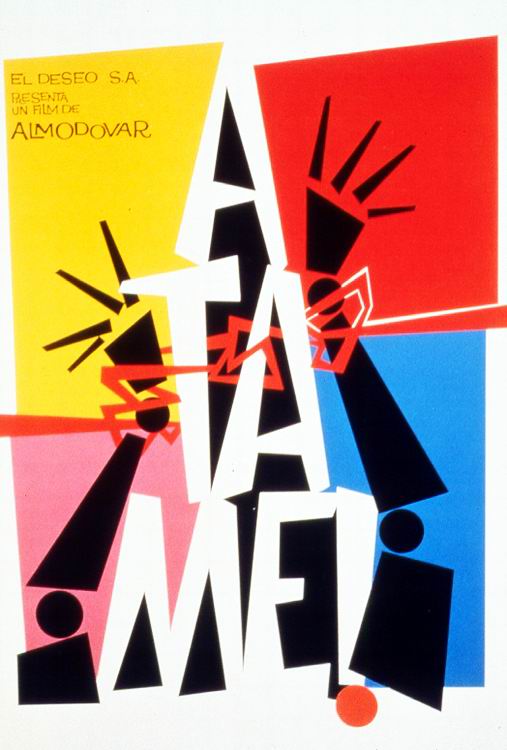
I just like the Saul Bass-ness of this one. It doesn’t work as well in the UK version because they try to fit ‘Tie Me Up! Tie Me Down!’ into the same space as ‘Átame!’.

Designer: Juan Gatti
I like the simplicity of this design, which again makes use of the colour red (the dominant colour within the film itself). The circle can be read in many ways –it puts the boy at the centre of a target (the priest pursues him), but it could also be a spotlight (pointing to the elements of ‘performance’ that surround Ignacio). The crossed arms also signal determination –something that can certainly be ascribed to Ignacio in his many different incarnations.

Monday, 8 August 2011

Reading Almodóvar, Part One:

Like my lists of books on Spanish cinema, this is something of a cross between an annotated bibliography and a recommended reading list. This is not intended to be a definitive list –there are an abundance of other books and articles on Almodóvar and his films– but rather a list of texts that I have happened upon while researching Almodóvar, and / or Spanish cinema more generally. I don’t necessarily agree with all of the arguments or interpretations set forth by these authors, but I do think that their views are worth considering. The first Almodóvar film that I saw was Kika (1993), and this list contains a bias towards things written after that point (and about films made after that point as well). Likewise, there is a bias towards texts written in either English or Spanish, but given Almodóvar’s status in France there is also a wealth of material in French out there, if you care to look for it –particularly Cahiers du cinema, Positif, and Premiere (the French version). Most of the French magazines have websites where you can buy back issues (if you can’t get access to them through a library).
If I have embedded a link in the title, it will take you either to the abstract or the article itself –a great deal of material is now available online. Where that isn’t the case I will try to include enough information that you should be able to track it down via another route –if you can’t access the articles online, people in the UK will be able to get copies through the British Library or the BFI Library. In the case of reviews, I have just indicated which film is discussed.

Monday, 1 August 2011

Almodóvar Month begins…


UPDATE 18/04/2026: I am removing most of the Almodóvar Month posts because of repeated copyright infringement claims from a company claiming to represent El Deseo - the claims get overturned when I appeal (because I haven't infringed copyright), but it has become quite irritating. I will leave the post about La piel que habito (as its release was the impetus for the blogathon), and the posts on books and posters, but remove everything on individual films because it seems to be the combination of an image with the synopsis and basic credits that triggers the claims.

So August has arrived, the countdown to the UK release (on the 26th) of La piel que habito / The Skin I Live In starts, and it’s Almodóvar Month here at Nobody Knows Anybody.
I haven’t managed to do quite what I wanted (in a previous post I said that I hoped to write about my ten favourite Almodóvar films), but I think I’ll actually manage to say something (however short) about all seventeen films and will write something about the eighteenth once I get to see it.

Here’s what will be appearing on the blog throughout August:
  • I’ve written a paragraph on each of the films and those will be posted up in chronological order with basic credits and a synopsis.
  • There will be an Almodóvar ‘book list’ in the style of the Spanish cinema ones I have posted previously.
  • There will be a series of longer posts looking at specific films –including High Heels, Live Flesh, Talk to Her, and Volver. These won't be going up in chronological order because I'm still writing the High Heels one.
  • There may also be some other things –for example, I’d quite like to write something about his film posters, but it depends on how much time I have.

Anyway, hopefully there’ll be something for everyone (providing they like the films), and please feel free to chip in via the comments section with your thoughts about the various films –have I underestimated one? Or over-praised another? 

Sunday, 3 July 2011

Agnosia (Eugenio Mira, 2010)


Director: Eugenio Mira
Screenwriter: Antonio Trashorras
Cast: Bárbara Goenaga, Eduardo Noriega, Félix Gómez, Martina Gedeck, Sergi Mateu, Jack Taylor
Trailer: short version (haven’t been able to find the subtitled full-length version) 
Availability: available to buy and rent in the UK.
Synopsis: Barcelona, 1899. Joana (Bárbara Goenaga) suffers from agnosia, a neuropsychological condition that affects her perception. Interested parties suspect that she is the only person who knows an industrial secret relating to her father’s business, and so a conspiracy evolves with the aim of obtaining the secret by deception. Two men, Carles (Eduardo Noriega), her fiancé, and Vicent (Félix Gómez), a servant, are her only form of protection. But can she trust them? And can she trust her own senses?

agnosia, n.
A condition in which people can see, but cannot recognise or interpret, visual stimuli; loss of perceptive power; loss of the power to recognise people or things seen.


Note: contains minor spoilers (although nothing that you couldn’t guess from the trailer).

Tuesday, 14 June 2011

More articles added to the Spanish cinema reading list


All of these articles come from issue 39 of Archivos de la filmoteca, the search for a copy of which became something of an unresolved Holy Grail-type quest during my PhD –the articles in this specific issue are repeatedly referenced in books and articles on Spanish cinema of the 1990s but it is really difficult to track down. I found this copy a few months ago through Abe Books but only bought it last month after deciding that my quest would not be complete until I actually had a copy (I’d been dithering because I no longer ‘need’ it). These are just the articles that look at some general issues in Spanish cinema of the period (although taking specific films as examples) –there are others in the issue that take specific films or filmmakers as the basis for the article, but I’m not adding those at the moment because I will eventually do a filmmaker / specific film list. The articles listed below have been added to Books on Spanish cinema, Parts One and Two

Benet, V.J. (2001) –‘El malestar del entretenimiento’, Archivos de la filmoteca, no.39, October, pp.40-53.
[Taken from the official abstract] This article looks at various film adaptations of Spanish novels, specifically those of Ray Loriga and José Ángel Mañas. The analysis examines the values and symbols reflected in these films, which differ significantly from films made during the Spanish transition to democracy. The article situates the relationship between these films and their literary sources within an economic perspective, taking leisure and entertainment as key cultural concepts.

Gámez Fuentes, M.J. (2001) –‘No todo sobre las madres: cine español y género de los noventa’, Archivos de la filmoteca, no.39, October, pp.68-85.
[Taken from the official abstract] This paper analyses the various images of motherhood through their configuration in ‘90s films such as El pájaro de la felicidad (1993), Nadie hablará de nosotras cuando hayamos muerto (1995), Solas (1999) and Todo sobre mi madre (1999). The different figures are considered as cultural products which articulate tensions contextualized at a particular historical moment: the consolidation of democracy in Spain. Through a detailed study of the maternal, such issues as job access, geographical origin and sexual identity are discussed within the framework of the private and public negotiations women are to be faced with in the new welfare state. The legacy of the dictatorial past is, undoubtedly, a question that also permeates the construction of female narratives -unfolded here in personal and historical complexity.

Quintana, Á. (2001) –‘El cine como realidad y el mundo como representación: algunos síntomas de los noventa’, Archivos de la filmoteca, no.39, October, pp.8-25.
[Taken from the official abstract] In contrast to traditional discussions of film and history, the author takes the concept of historicity to examine the relationship between thought, culture, and art at a specific moment in the history of cinema. As point of departure, the article takes the commonly cited crisis of reality in Spanish cinema of the 1990s, in particular three significant cultural phenomena: the identity crisis, excessive images of violence, and the transformation of the world into a gigantic Platonic cave. These phenomena are observed in the various models of Spanish film of the 1990s, where a new generation of filmmakers aim to situate their films within the cultural logic of postmodernity. The author affirms that representative figures in Spanish film are a symptom of the global crisis of the real that is affecting the world, dominated by a loss of faith in the media and the creation of new spatial and temporal dimensions in a virtual sphere.  

Monday, 30 May 2011

New poster for Blackthorn


Via Trailers y Estrenos

It's not my intention to post every new Spanish film poster that comes along but, as I've already posted those for La piel que habito and Extraterrestre, I thought that this one should also go up as it is another of the four forthcoming (in 2011) Spanish films that I'm most interested in.

In other news: Yes, it has been a bit slow on here recently (I've had to prioritise other things), but it should start to pick up again in the next couple of weeks.

Saturday, 21 May 2011

New poster for La piel que habito


Via tío Oscar

This is the new poster for Almodóvar’s La piel que habito (which looks like a photo from a distance but is actually a painting), and there are also new images and clips in circulation (for example, see La Katarsis del Cine Español). I’m not going to post much more about the film now until it has its release in the UK (which now looks like it will be the end of August rather than November) –I’m deliberately not reading the reviews coming out of Cannes because I’d rather go in knowing as little as possible. Nobody Knows Anybody will also be having an Almodóvar month closer to the UK release, so when the date seems a bit more concrete (it seems odd to me that we would get the film before Spain (where it has a September date)) I’ll post some details about that.
Fingers crossed tomorrow for Pedro & co. at Cannes.

Thursday, 5 May 2011

New Book Added to List

I have added this book to the list in Part One of the Books on Spanish Cinema posts [reasons for creating the list are explained in there]:


Davies, A. (ed.) (2010) –Spain on Screen: Developments in Contemporary Spanish Cinema, Basingstoke: Palgrave Macmillan. ISBN: 9780230236202
This collection stems from a one-day symposium on contemporary Spanish cinema held at Newcastle University in July 2008. I was in the audience at that symposium and there were some very interesting discussions –these articles are mainly extended versions of the papers given that day (with a few written especially for this book).
Introduction: The Study of Contemporary Spanish Cinema –Ann Davies
Audiences, Film Culture, Public Subsidies: The End of Spanish Cinema? –Barry Jordan
Al mal tiempo, buena cara: Spanish Slackers, Time-images, New Media and the New Cinema Law –Rob Stone
Re-visions of Teresa: Historical Fiction in Television and Film –Paul Julian Smith
The Final Girl and Monstrous Mother of El orfanato –Ann Davies
Ensnared Between Pleasure and Politics: Looking for Chicas Bigas Luna, Re-viewing Bambola –Santiago Fouz-Hernández
Javier Bardem: Costume, Crime, and Commitment –Chris Perriam
Children of Exile: Trauma, Memory and Testimony in Jaime Camino’s Documentary Los niños de Rusia (2001) –Julián Daniel Gutiérrez-Albilla

Friday, 15 April 2011

Books on Spanish Cinema, Part Two

This is Part Two of the list that I started yesterday (see Part One here).

Part Two: Authors J (continued) - Z


Thursday, 14 April 2011

Books on Spanish Cinema, Part One

This post is inspired by my attempts a couple of weeks ago to discover which films were covered in an edited collection of articles on Spanish films. I was looking for info about / analysis of La madre muerta and I knew that the book in question looked at key Spanish films –but could I find a list of contents anywhere? No. Not on Amazon, not on the publisher’s website, not on the public library catalogue. I eventually tracked down a copy in one of the university libraries in this city (it didn’t have anything about La madre muerta, incidentally), but this reminded me that the recurring problem that I have had when buying books about Spanish cinema, especially when the books are in Spanish, is that I effectively have to buy ‘blind’ because there is so little information about the book available online. This is especially true on websites such as Casa del Libro, which lists very little information beyond author, title, and publisher, but Amazon is equally as bad with edited collections (where you are often given no indication of what topics are included, or who has written the various articles) and books not in English. Note to publishers: putting some kind of content information online would net you more sales.
    
So, I’ve decided to be helpful (at least, this would have been helpful to me in the past).
    
What I’m going to do is this: with books that are written by one author, I will write a (very) brief summary of the book; with the edited collections, I will include the list of contents; and if an article is available online, I will link to it. I’m not going to translate the titles of articles that are in Spanish because there is little point given that the article itself will also be in Spanish. The aim for this resource is that it will be a cross between a recommended reading list and an annotated bibliography –I may write some book reviews of some of the books included at a later date, but that is not the purpose of this particular post.
First up will be books / articles that are about Spanish cinema in general (I will post something about books on directors / actors / specific films at a later date) –this is going to be split across more than one post because I’ve got rather a long list. The books / articles are being chosen by two criteria: 1) I’ve read them and currently have access to a copy (I can’t get the information without the physical copy) and 2) they relate to the period that I’ve said this blog is going to cover (the last twenty years). The latter point is why some older books by significant authors are not included. The list is in alphabetical order by author because that’s the most straightforward way to do it. If you think that I’ve left a glaring omission (especially for books in Spanish –buying blind means that my collection is a bit hit and miss), please leave a comment below. Likewise, if you’ve got something to say about the books included, please join in as well!
If you’re in the UK, most of these books can be obtained from the British Library via the Inter-Library Loan system. If you want to buy any, I’d recommend comparing the prices available between Amazon, Casa del Libro, Ocho y Medio, The Book Depository, Alibris, and Abe Books –there are bargains to be had if you do some searching (but likewise there are some people –on Amazon in particular- selling second-hand copies for absurdly high prices).
Ok, let’s get started!


Friday, 11 March 2011

Anatomy of a scene: La madre muerta (00:21:12-00:23:11)

Ismael has one of those days where everything goes wrong

This is the start of what will be an occasional feature on the blog. I won't do it for every film I look at, but some films have a scene that just perfectly captures the sensibility and / or themes of the film as a whole. In the case of La madre muerta, I could have chosen the ‘Aguadilu’ scene because that is also a good illustration of the tone of the film and the fine line that it walks between humour and uneasiness. However I’ve chosen this one because a) it is darkly funny, and b) it is a brilliant set piece. Plus it occurs only twenty minutes into the film, so I can’t be accused of spoiling the plot. Juanma Bajo Ulloa considers it to be one of the best sequences in the film because of how it creates a sensation of fear (something is going to happen to the grandmother, but we don’t know exactly what) and combines both suspense and absurd humour.

The story so far: The prologue of the film sees Ismael (Karra Elejalde) shoot and kill a woman who disturbs him during a burglary, and ends with him pointing his shotgun at the head of the woman’s small daughter. Fifteen years later, Ismael spots the girl (Leire -now grown up and played by Ana Álvarez) in the street with her grandmother. Despite the fact that she is mute, and has the mental age of a three-year-old, he becomes convinced that she recognises him and could identify him to the police. As a result, Ismael announces to his girlfriend that he plans to kidnap and kill Leire. In the lead up to this scene, we have seen Ismael tail Leire and her grandmother as they make their way home from the clinic where Leire spends her days. He casually follows them into their apartment block, and then it cuts to….


Thursday, 10 March 2011

Links roundup, 10th March -mainly about Ángel Sala

    The main story of the week is that of Ángel Sala, director of the Sitges Film Festival, who was reported to the Barcelona authorities and accused of exhibiting child pornography, on the basis that A Serbian Film (the ‘plot’ of which includes the rape of a baby and of a five-year-old child) was screened at the Sitges Film Festival last October. This has predictably caused uproar and prompted accusations of censorship, and expressions of disbelief that the judiciary cannot tell the difference between fiction and reality (although, as I understand it, Spanish law does not differentiate between ‘fiction’ and ‘reality’ in terms of images of this kind, and the specific article of the penal code (189.7, according to El País) covers the production, selling, distribution, exhibiting, or facilitating of such images).
     Leaving aside the issue of censorship for one moment, the main point of absurdity seems to be that the person who is facing a prison sentence of three to twelve months (and Sala was formally charged on Wednesday 9th March), is someone who was not directly involved in the making of the film –the letter of support signed by the directors of other Spanish film festivals notes their surprise (and, no doubt, alarm) that it is a cultural programmer who is being pursued, rather than anyone who can even theoretically be held responsible for the film’s content. I hold no brief for A Serbian Film –given what I have read about it (Empire's review –yes, it was released in the UK, although cut by the BBFC- is here), I have no desire to see it. But I am an adult and am capable of making that decision for myself. After Sala was charged on Wednesday, the Sitges Film Festival released a statement making clear: a) their continued support for their director, b) that the film is a work of fiction, and c) that strict precautions were taken to ensure that only adults attended the (one) screening of the film. We can only wait to see what happens next. In the meantime, an online petition in support of Ángel Sala has been started.

Other news-

The on-going story of who will take over from Álex de la Iglesia as President of the Spanish Academy of the Arts and Cinematographic Sciences: last week director Bigas Luna threw his hat into the ring. However the elections are for a team (President and two Vice-Presidents) rather than just a President, so Bigas Luna had been looking for two other people to serve with him. He had said that he wanted someone from the acting community and someone from the production side of filmmaking. Earlier this week it was announced that actress Leonor Watling (Hable con ella / Talk to Her (Almodóvar, 2002), and perhaps more pertinently, Son de mar / Sound of the Sea (Bigas Luna, 2001)) and production manager / line producer Yousaf Bokhari (Balada triste de trompeta (de la Iglesia, 2010)) will stand as the two Vice-Presidents in collaboration with Bigas Luna. As yet no other candidates / teams have announced that they intend to run.


Friday, 25 February 2011

Pa negre / Black Bread (2010)


Director: Agustí Villaronga
Screenwriter: Agustí Villaronga, based on the book by Emili Teixidor
Cast: Francesc Colomer, Marina Comas, Nora Navas, Roger Casamajor, Laia Marull, Eduard Fernández, Sergi López.
Availability: the film is due out on DVD (with optional English subtitles) in Spain in March, and is currently available on the streaming site Filmin, here.

The silent knowledge of unquiet graves necessarily produced a devastating schism between public and private memory in Spain’ –Helen Graham (2005: 137)

Monday, 14 February 2011

The 25th Goya Awards: the winners

At the moment the official website for the Goyas seems to be inaccessible -when I'm able to get onto it, I'll add some links here. In the meantime -
El País has the full list of winners here
Fotogramas have photogalleries of the red carpet, the show, the winners, and video footage.
Pa negre was the big winner, winning 9 Goyas out of 14 nominations including Best Film, Best Director, and 4 of the acting categories. The other frontrunners fared less well –También la lluvia (13 nominations) picked up 3 (Supporting Actor, Music, and Production Direction), as did Buried (Sound, Editing, Original Screenplay), and Balada triste de trompeta won 2 of its 15 categories (Make-Up and Special Effects).
The main categories were as follows:

Álex de la Iglesia’s Goya speech, 13th February 2011:

Someone has probably already translated this somewhere, and Alt Film Guide has a condensed version here, but this is my translation based on the transcript that El País put online almost immediately after the speech was given (they also have video). Please let me know if there are any errors (there were a couple of phrases I was unsure of).

Thursday, 10 February 2011

Resources: where to buy / watch / read about Spanish cinema

Films and DVDs –
      The UK distribution of Spanish films on DVD has improved in the last few years, and there are a number of options in terms of buying them within the UK. Amazon UK currently has quite a lot of Spanish DVDs for under £5 (go into DVD > World Cinema > Spanish) and Moviemail also often have good offers on foreign language cinema. However there are a lot of Spanish films that don’t get released over here but are released in Spain with optional English subtitles (this is more true of contemporary films than older classics, but there is nonetheless a wide range available with subtitle options). If you’re unsure about ordering from Spain, there are quite a lot of Spanish sellers selling Spanish DVDs on ebay UK (DVDs > Foreign Language > Spanish) –the prices sometimes seem a little steep but consider that they quite often offer free postage and have factored that into their asking price (standard postage for one DVD being sent from Spain to the UK seems to be around 12€). I have ordered DVDs through ebay in this way and have never had any problem.