Sunday, 1 December 2013

Coming Attraction: The Late Show


    The past couple of years I've enjoyed reading the various contributions to Shadowplay's annual Late Films Blogathon, but have been too disorganised to take part myself. This year, when I saw David Cairns's first callout, I thought "Right, get to it!" and had a think about what I could contribute. 
    The idea is to write about a film from late in a person's career - sometimes people go out with a bang, and sometimes with a whimper. It doesn't have to be a recent film, or someone who has recently died. But Spanish cinema has had many losses in 2013 (in a multitude of contexts), so I thought that I would focus on someone who had died in the past year. There are many big names on that roll call - producer Elías Querejeta, directors Bigas Luna and Jess Franco, the iconic Sara Montiel, for a start. I tend to write about actors more than directors, so I thought I'd write about an actor who is iconic in Spain, but little known abroad: Alfredo Landa. Unfortunately his last film, Luz de Domingo / Sunday Light (José Luis Garci, 2007), is a dud (Tyne Tees' Catherine Cookson dramas were directed with more verve) but I'm hoping to be able to link it back to his earlier films and come up with something interesting. My post will go up later in the week, but in the meantime keep an eye on Shadowplay as David Cairns will be linking to the various blogs taking part.


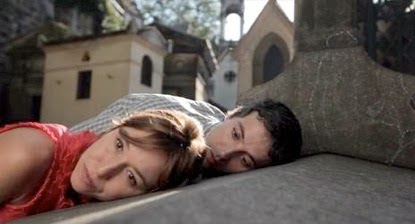
Alfredo Landa in his first screen role in the brilliant Atraco a las tres (José María Forqué, 1962)

Wednesday, 20 November 2013

Guest Post: Michael Pattison - Notes on Some Spanish Films at the Seville European Film Festival

     Though their country’s economic plight worsens daily, Spanish filmmakers are beginning to assess and get to grips with a political climate that is, in the final analysis, antagonistic to artistic endeavour. While films ineluctably express the complex, contradictory tensions that characterise the social context in which they are made, the aim and hope is that any historical period finds its artistic match: those works that grasp the matter at hand, embrace the difficulties ahead, and refuse to evade the work to be done. To this end, there were a significant number of Spanish films at the tenth Seville European Film Festival (SEFF) whose general focus and political persuasion spoke of a palpable discontent with regard to the current state of things. Not every film will be politically charged, of course, and so it is to SEFF’s credit that it waded through what I presume to be a large swamp of mediocrity in order to present, by and large, the strong selection it finally offered. These works speak to the present precisely because they convey an understanding – to varying degrees – of how they relate to the unfolding historical moment.

Costa da morte / Coast of Death
     I have written elsewhere here and here   on Lois Patiño’s Costa da Morte, but some further remarks won’t go amiss (I first saw the film in Locarno in August, and again at the Viennale prior to my arrival in Seville). An essay film on the eponymous Galician coastline – named so because of its history of shipwrecks – Patiño’s debut feature frequently surveys its region from afar, zoomed-in so as to flatten its landscapes and thereby deny a more visually harmonious vantage point. There’s something unnatural about such optical choices: as humans, we cannot, after all, get a closer look at an object without telescopic aid or without physically moving to a closer proximity. Consequently, the film enables an unspoken but ongoing commentary on its own function: in denying itself and its audience a postcard-friendly view of the Coast of Death, it suggests a better understanding of these locales might come from a more idiosyncratic view. By flattening the landscape in such a way, Patiño’s film pits a multiplicity of histories against one another, privileging none and including all. Just as every landscape is the sum of its parts, so the present is the sum of its pasts. Note the plural: at no point in history has there been a moment without contradictions – the remnants of a bygone time, the formations of an era to come. 

El Futuro / The Future
     El Futuro takes an aesthetically different approach to history. Set in the immediate aftermath of Spain’s 1982 General Election – which was won by the Spanish Socialist Workers’ Party – Luis López Carrasco’s debut feature confines itself to a house party attended by a group of increasingly inebriated twenty- and thirty-somethings hell-bent on indulging the post-Franco night away. When I saw the film at Locarno in August I couldn’t write the soundtrack list in its end credits down fast enough: this boasts an infectious selection of the Euro-synth and -punk of the period, and lends the narrative a real verve. There’s something futuristic about electronic music, of course, and yet ’80s synth – as well as other fashions from that decade – seems to have dated quicker than most. Likewise, the forward-thinking euphoria facilitated by a socialist party’s assumption of governmental responsibilities now seems a distant memory: López Carrasco’s ironically-named film is anything but optimistic, and the textured grain of his 16mm compositions reminds us at every turn of its own retrospection. Every smile, laugh and suggestion of a future appears as a ghost prohibited today by Spanish Prime Minister Rajoy’s enforced austerity.

El triste olor de la carne / The Sad Smell of Flesh
    Mariano Rajoy is a secondary character in El triste olor de la carne, the second feature by Cristóbal Arteaga Roza. Having his first state-of-the-nation address in February this year overheard in intermittent snippets here recalls Andrew Dominik’s similar employment of Barack Obama soundbites in Killing Them Softly (2012). Unlike that film, however, El triste olor de la carne has no time for allegory: a single-take trudge through Madrid’s urban sprawl, it takes one citizen’s financial loss to its logical, literal and inevitable (if no less powerful) conclusion. Said citizen is Alfredo (Alfredo Rodríguez), an uncanny cross between Boris Karloff and Peter Capaldi, his visibly fatigued face saying more than the character ever does, as he tries desperately to defer a meeting with the bailiffs who are coming to repossess his home.
     When a recession begins to affect the perfect image of a white middle-class nuclear family, you know you’re in trouble. Alfredo’s burnt-out businessman is a figure of belated if bewildered acceptance, and the only resistance he can summon rings, in the end, all too true. Though some critics might feel its persistent, unbroken take results in unnecessary bouts of dead time – such as when Alfredo is driving, or else travelling on a bus or in a taxi – this is precisely the film’s strength, lingering as it does on those unbearably long passages in which unthinkable stress drains a person’s life away. Indeed, the prospect of financial collapse is now too familiar a prospect for many Spanish people that contrived dramatics are no longer necessary.

Alegrías de Cádiz / Joys of Cádiz
     Not every Spanish film at SEFF felt like it was making a significant contribution to the battle. Gonzalo García Pelayo’s Alegrías de Cádiz returns its director to filmmaking after three decades in other fields, and feels very much the product of someone lacking practice. (For a serviceably flashy take on García Pelayo’s venture into professional gambling in the 1990s, see Eduard Cortés’s The Pelayos (2012)). Anyone familiar with the director’s work – pseudo-cerebral, flesh-heavy forays into the beauty of women, the joys of sex, monogamy as a socially conditioned and therefore unnatural state, and so on – will not be surprised to hear this is a heavily indulgent work. Not without its lively moments, the film is an uneasy blend of a meta-comedy about a ménage-à-trois and a sincere essay film on Cádiz. As such, it keeps itself busy for its two-hour running time, but García Pelayo’s implication-cum-assertion, that the most interesting thing about a city is its women, seems like a perverted joke.

10.000 noches en ninguna parte / 10,000 Nights Nowhere
     Other films disappointed. 10.000 noches en ninguna parte, by Malaga-born writer-director Ramón Salazar, is a centrifugal triptych on themes of loss and – of course – love. Wide-eyed Andrés Gertrúdix plays the same character thrice, living in parallel dimensions: with a bohemian trio in Berlin, with a childhood love in Paris, and with his alcoholic mother in what I presumed to be Spain. A dull, cold visual palette – with shallow-focus camerawork – gives the film a terminally malaised look, and though a certain whimsicality forces its earlier passages along, the employment of Arvo Pärt’s overused ‘Fratres’ reveals an essentially juvenile sensibility at work. Indeed, at a certain point during the film I wrote in my notebook: these people don’t live in the same world as me – the real world, with financial pressures etc

Los chicos del puerto / The Kids from the Port
     Nor do the protagonists of Los chicos del puerto, by Alberto Morais. The film’s eponymous port is that of Valencia, and its kids are Miguel, Lola and Guillermo, three pre-teens who embark upon the ostensibly simple trek to a cemetery, to place an army jacket on the grave of the recently deceased friend of Miguel’s grandfather. The pilgrimage of course turns out to be more arduous than first assumed. The friends underestimate their bus fare; they journey to the wrong cemetery; they become lost; they grow hungry; they go broke. That one-note tone of dramatic seriousness – more familiar to French productions than to Spanish – sets in quickly: characters act not how people do, but for a desired symbolism, one which over the course of even a slim 78 minutes drains all would-be energy. Programme notes mention “sparse dialogue and a formal Bressonian minimalism”, but the invariably stilted interactions here are part of a wider filmmaking trend that may very well be indebted to Bresson but which provides too little social commentary to justify the comparison. Too many filmmakers seem to mistake this sullen, ploddingly mopey register for mysteriousness, for ambiguity, for poetry or for purity – or for any other apparently desirable trait.
     All the more refreshing, then, to watch more upbeat films like El Rayo, Un ramo de cactus and Las aventuras de Lily ojos de gato. The first of these, directed by Fran Araúgo and Ernesto de Nova, screened in SEFF’s ‘Andalusian Panorama’ section following a world-premiere at San Sebastian, and sees a defiantly high-spirited itinerant labourer trekking across Spain back to Morocco on a tractor. The second, which received its world-premiere at SEFF as part of the festival’s inaugural ‘Resistances’ strand, is a pleasing if sometimes technically amateurish comedy by Pablo Llorca, featuring a deceptively masterful central performance from Seville-born Pedro Casablanc, who has in recent years been ubiquitous on Spanish television. Casablanc’s deadpan style and pockmarked face recall Bill Murray, and his turn in Llorca’s film – as a fiftyish farmer at odds with his family’s acceptingly money-oriented ways – deserves much wider recognition. In contrast to a film like Los chicos del puerto, both Un ramo de cactus and El Rayo demonstrate that a serious film need not be glum.

Las aventuras de Lily ojos de gato / The Adventures of Lily Cat Eyes
     Las aventuras, meanwhile, is a night-in-the-life-of tale centring heavily on inebriation as a means to forget. Working as a PR for a bar in Madrid, Lily (Ana Adams) meets a bleary-eyed customer with whom, after hours, she solemnly swears to drink till she hits the ground – and perhaps would if real-life events didn’t get in the way. To be sure, Lily is drinking away the hurt of a break-up, but her temporary escape is frustrated by more pressing matters: a friend’s pregnancy, her new pal’s paralytic state, an abusive employer, and so on. A more systemic understanding of things might be beyond Boix and his film; I would have preferred a less cartoonishly cruel boss, for instance. And though these are palpably more universal features with which to pepper a story – as opposed to the characteristics of the Galician landscape, or the political fate of Spain – the film nevertheless has an undeniable strength, in taking an otherwise insufferable young drunk and accounting for her self-destructive behaviour in a non-evasive way. Played by British actress Adams – who speaks Spanish fluently – Lily has a rugged, get-on-with-it edge, which makes her charming even when she’s actively derailing a blues performer’s final song in a late-night bar.


Michael Pattison is a freelance film critic based in Gateshead, UK. He blogs at idFilm and Tweets @m_pattison.

Thursday, 24 October 2013

Tangled Ideas, part 2


So, having rewatched Biutiful, and started to do a close reading of a couple of sequences of Los lunes al sol, I have come to some conclusions in relation to the points I raised in my previous post on the subject.

  1. I can no longer see whatever it was in Biutiful that so strongly pushed me towards Los lunes al sol (or only at a very superficial level - Bardem's performance in the later film is in many ways a physical reversal of what he did in the earlier one). This is more than a little irritating.
  2. Given the length of what I want to write, I think I have two separate ideas - one that relates to how Bardem's performance style and star image coalesce (and reinforce one another), and one that is about how Bardem's presence in a film shapes Spanish critical reception of that film. There is an overlap between the two things, centring around the issue of genre, but I think they can be separated out. Hopefully.
  3. My intention is to start with the first idea - mainly focussing on Los lunes al sol but also bringing in Biutiful (and some of his other films - yet to be decided). But I need to come up with a central 'hook'.
  4. I find the issues raised by the second idea intriguing, but I don't currently want to be looking at the reception side of things - I need to focus on the films themselves for a while. So this may be something I come back to, but in a smaller way.
  5. I'm going to have a think about how I would word an abstract for the first idea, to see if that can focus my argument.
  6. I have been working on a close reading of Los lunes al sol's longest sequence - the seven-minute-long argument in the bar - which I may work into an 'Anatomy of a Scene' post as a way of getting started with thinking specifically about his performance.

In addition to that, I am also starting to research a more general piece about Spanish stardom (covering a broader period than I have previously investigated) - as I start to watch films for that, they'll appear as 'random viewing' posts, but otherwise the blog will be pretty quiet as I try to get to grips with these two 'projects'.

Thursday, 19 September 2013

Open Your Eyes

Abre los ojos (Alejandro Amenábar, 1997)

Vanilla Sky (Cameron Crowe, 2001)

Thursday, 12 September 2013

Tangled Ideas


    You develop a funny attachment to films that feature in your thesis. Not all of them (there are a few that you'd have to pay me to watch again), but I think certainly the ones that find themselves woven into the central fabric of your central argument; you are infinitely aware of their defects and flaws (you've pored over their minutiae for months, taking them apart and holding them up to the light), but you bristle slightly if someone else points them out. But once you've submitted, the idea of revisiting one of those films (for enjoyment!) doesn't appeal; it's difficult to view those films from any other perspective than the one through which you wrote about them in such detail. But this is where the funny attachment comes in for me because there are some that I nonetheless regard with what can only be described as affection, of which Los lunes al sol is one. There is something about the film that moves me no matter how many times I watch it, or how I've dissected it in the past: it is a film about solidarity, loyalty, about people being stronger together, and about how friendship can keep you afloat in the worst of times. Much of this centres on Bardem's character, Santa, the pillar of a group of friends laid low by unemployment. If I were told that I could only watch one Bardem performance again, this is the one I would choose; in part because it is a perfect encapsulation of what 'Javier Bardem' and his star image mean within Spanish cinema, but also because I personally think that he has yet to better this performance.
     But I thought that I was 'done' with the film in terms of writing about it. Then in September 2011 I watched Biutiful and throughout the film Los lunes al sol kept tugging at my consciousness. A week or so later I watched León de Aranoa's film for the first time in at least two years. But you can see from this post that I couldn't quite articulate what it was that kept snagging in my brain, other than it centred on Bardem's performance (try not to laugh at my hugely optimistic assertion that I would write about the two films together within the next month - although, that said, I have found what I initially started writing in 2011; more than 3000 words, all of them about Los lunes al sol) and the feeling that Biutiful was a turning-inside-out of his earlier performance. And then life got in the way. I wrote a few of New Year's resolutions at the start of 2013 and one of them was 'Write the Bardem Los lunes/Biutiful article'. My attempts to restart my research focussed on my conference paper in the first half of the year, but it finally seems like time to actually get on with the bloody thing. So I rewatched Los lunes al sol this past weekend (I'd actually forgotten that I'd watched it in 2011 - I thought it was four years since I'd seen it) with fresh eyes and a sense of relief that this 'old friend' had not changed beyond recognition. I'll now have to rewatch Biutiful as well, but one step at a time.
    Performance is still at the centre of what I want to pick apart between the two films but in combination with the issue of genre and the associations that Bardem brings with him. I'm not sure whether I've got two ideas fighting each other, or just one that I've not properly untangled yet. 
    My intention is to look at the associations that Bardem's presence generates (at least in Spain) particularly in relation to cine social, before moving on to his performances in the two films, alongside criticism of the films that specifically relates to genre and their treatment of social issues. I think that Los lunes al sol addresses its themes, and wears its social conscience, with greater skill than Biutiful, but also better utilises Bardem and certain elements of his star image. It's not that there are obvious similarities between the films (they are quite different in terms of both visual style and their treatment of their respective subjects) but rather that Bardem's character and performance in the latter strongly reminded me of the earlier film because of the way that the performance seems (to me) to be a turning-inside-out of the earlier one. I don't think that Biutiful is cine social by any straightforward definition (but is genre ever clear cut? Los lunes al sol could be viewed as containing elements of melodrama as well) - but what is interesting is how it has been shoehorned into that genre by certain critics (particularly in Spain), and then judged as having failed to meet 'the standard' (again, particularly in Spain - both films have received their share of scathing critical commentary*). I think that this shoehorning is partly because of the associations that Javier Bardem brings with him for a range of reasons, but namely his style of acting (which is where the performance/genre overlap comes in).
    What I may do initially is use the blog to write about his performance in each film, so as to ground myself in them and to clarify what I'm grasping for by actually having to put what I think he does through his performances into written words. And then I'll have to do battle with genre and sort out my argument. But I think that if this nugget of an idea has stuck with me for two years while I've flailed around doing other things, then I should probably follow it. I'm putting all of this up here so as to hold myself to it because I find it far too easy to carry around ideas in my notebook without attempting to develop them - so feel free to give me a nudge if nothing appears on here in the next month!


*One of my favourite 'takedowns' of Los lunes al sol comes from Fecé and Pujol, who describe the film as ‘bienintencionada […] aunque conviertan el paro y la lucha de clases en una hipotética canción de Eurovisión cantada en esperanto: Si todos los parados del mundo caminasen cogidos de la mano’ ['well-intentioned [...] although they convert unemployment and the class war into a hypothetical Eurovision song sung in esperanto: if all the unemployed of the world could walk along hand in hand'] (2003: 161-162) - which is cutting but nonetheless makes me chuckle every time I read it. Biutiful's scathing commentary is more wince-inducing than funny (I think I tweeted some of my favourites when I watched it).